 Draftward
Essays worth reading,
from pitch to published.
You bring the idea. The AI interviews you, structures your argument, checks every fact, and drafts in your voice — through a disciplined, multi-pass edit. Not a one-click generator. Not a slop machine.
Free for 30 days · no credit card · then $5 a month.
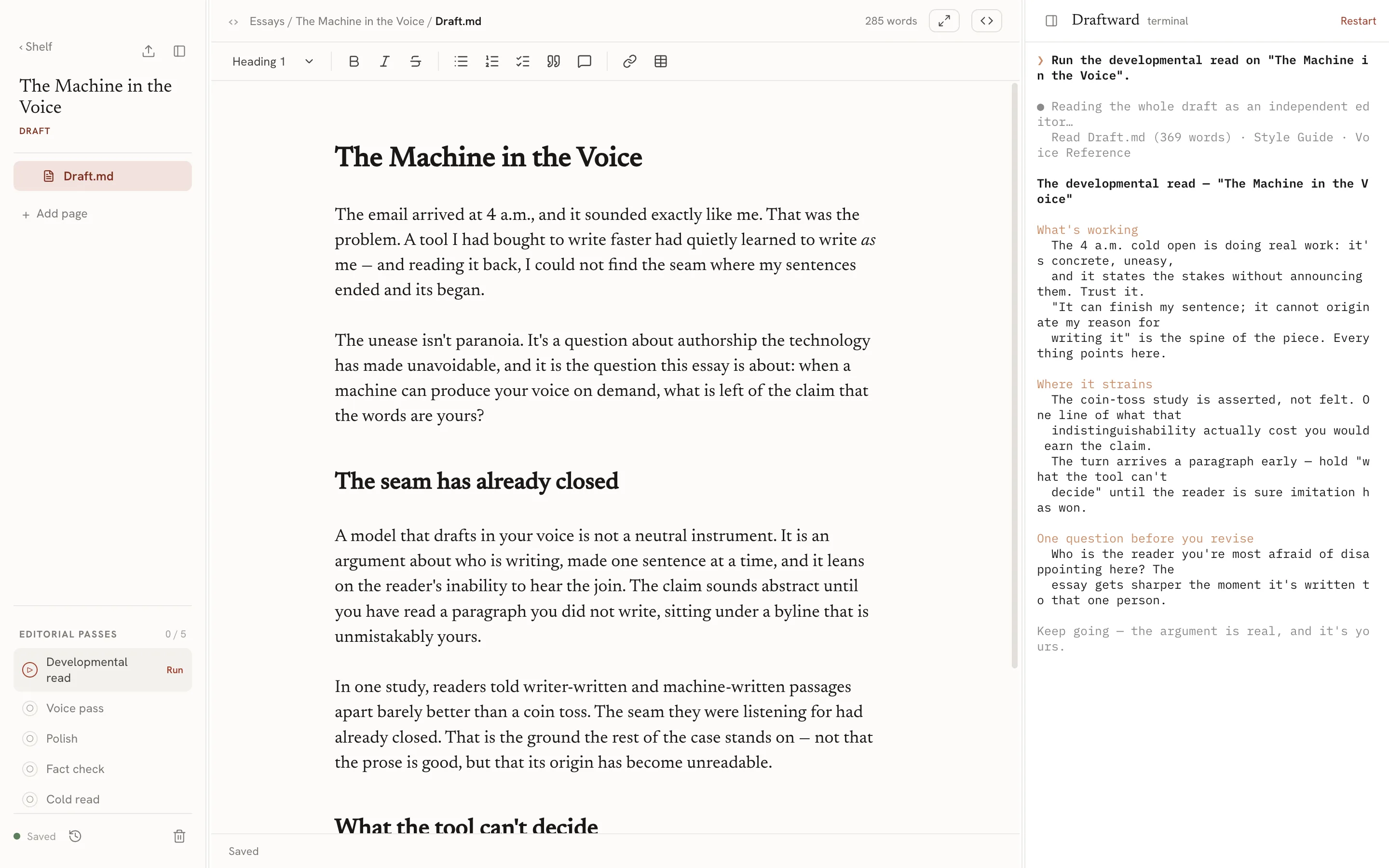
Draftward is built for work good enough to run in a publication you respect — not a keyword mill. You are the writer. You approve every step. The goal is a finished piece, not churned-out filler.
From a one-line pitch to a finished essay.
It works like a developmental editor: it interviews you, organizes your thinking, checks in at the seams that matter, and keeps moving through the routine work. How collaborative each stage gets is up to you.
Every essay in one place, outline to done.
Draftward opens to your shelf — every piece you’re working on, badged by where it is, with your style settings one tap away. No projects to juggle, no cloud to sign into: just your writing, as plain Markdown files on your own Mac.
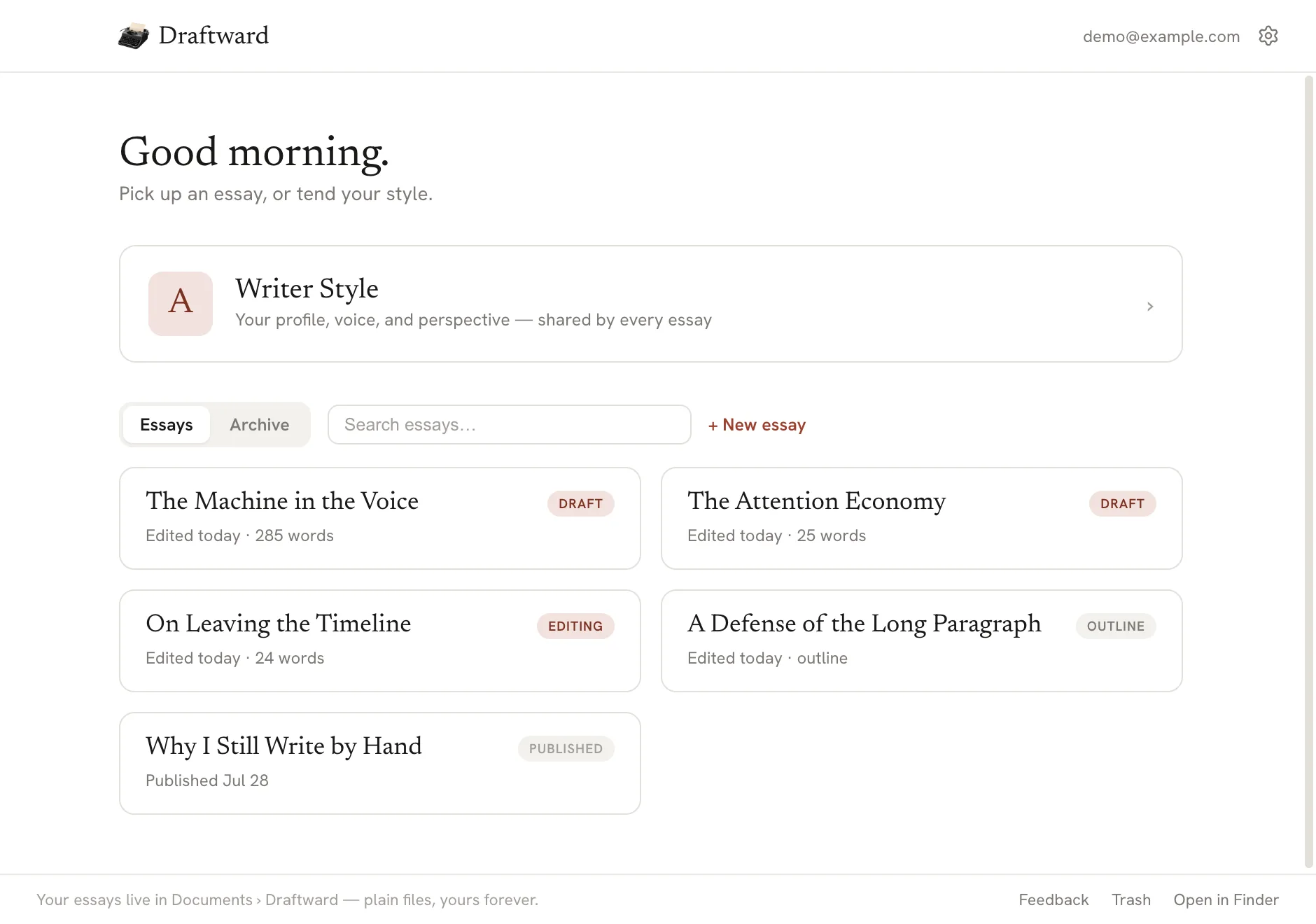
Outline, draft, editing, published — you always know what each piece needs next.
Everything lives in Documents › Draftward as Markdown. Open it in anything; nothing is locked in.
Open an essay and you’re at the desk from the hero — your pages, the draft, and the editor’s read side by side, with the five editorial passes tracked down the left.
A developmental editor, not a yes-machine.
It pushes back.
If your argument is weak, your evidence doesn't support your claim, or your angle is the one everyone else has, it'll tell you. That's a feature.
Every claim, sourced.
Each claim is verified against its source. If a source doesn't say what the draft claims, it's flagged before you publish.
Sounds like you.
It reads your published essays and best passages and drafts to sound like you. Your own writing always outranks anything borrowed.
Picks up where you left off.
It reads your brief, research, and style guide before writing or editing. No repeating yourself across sessions.
No cloud. No lock-in. No per-word billing.
Already paid for.
Use Claude (any paid plan) or ChatGPT (Plus or Pro). Draftward is a flat $5 a month on top — never metered by the word.
Files on your disk.
Manuscripts, plans, and research live as Markdown on your computer — open them in anything. Obsidian is optional.
Permanently yours.
Your essays, research, and voice files are yours alone. Anything you create — including work you sell — is entirely yours.
One desk, seven ways to read.
Seven built-in themes, each in light and dark, from a clean proof sheet to warm newsletter paper to true midnight. Every screenshot below is the real editor — pick a mood:
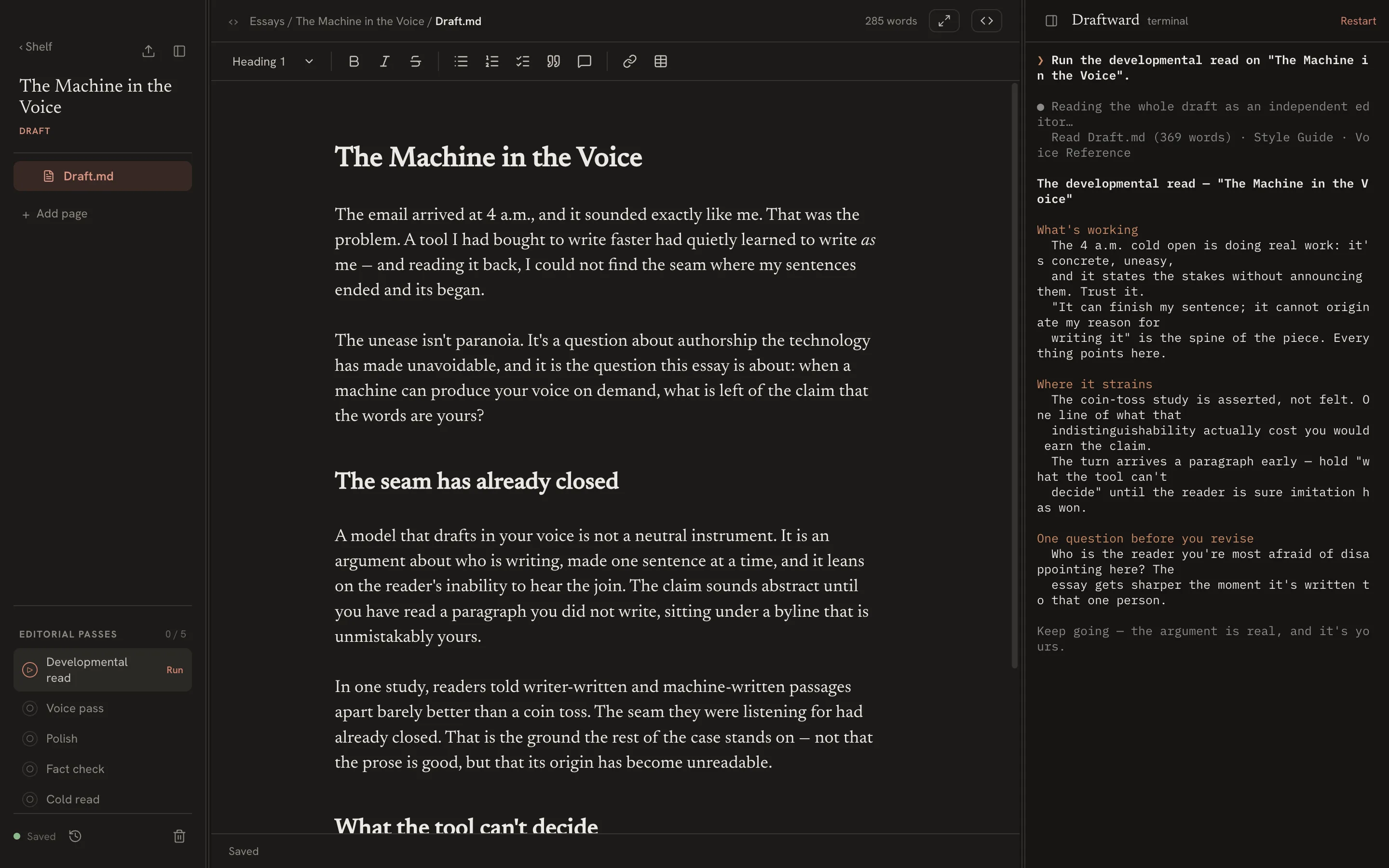
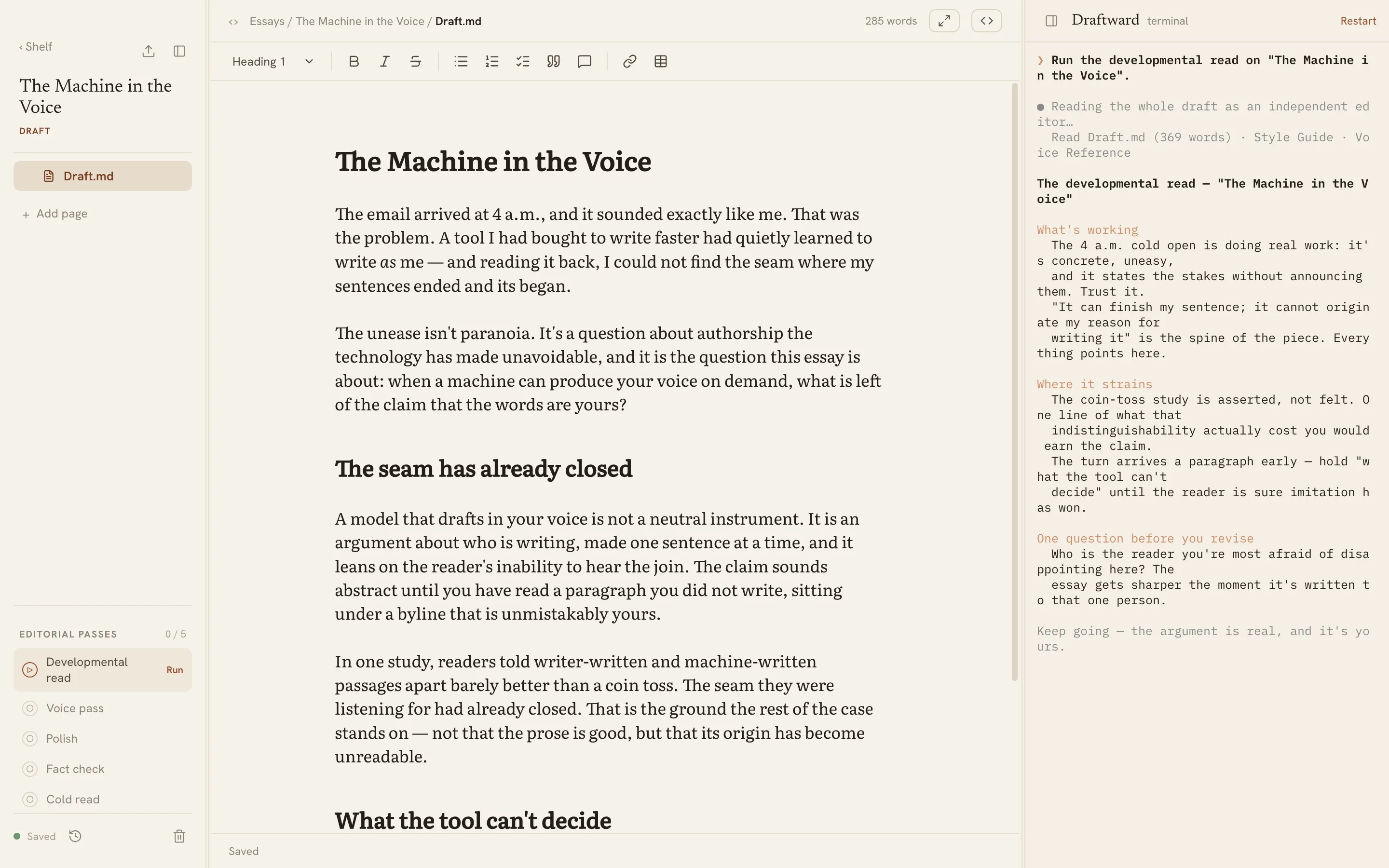
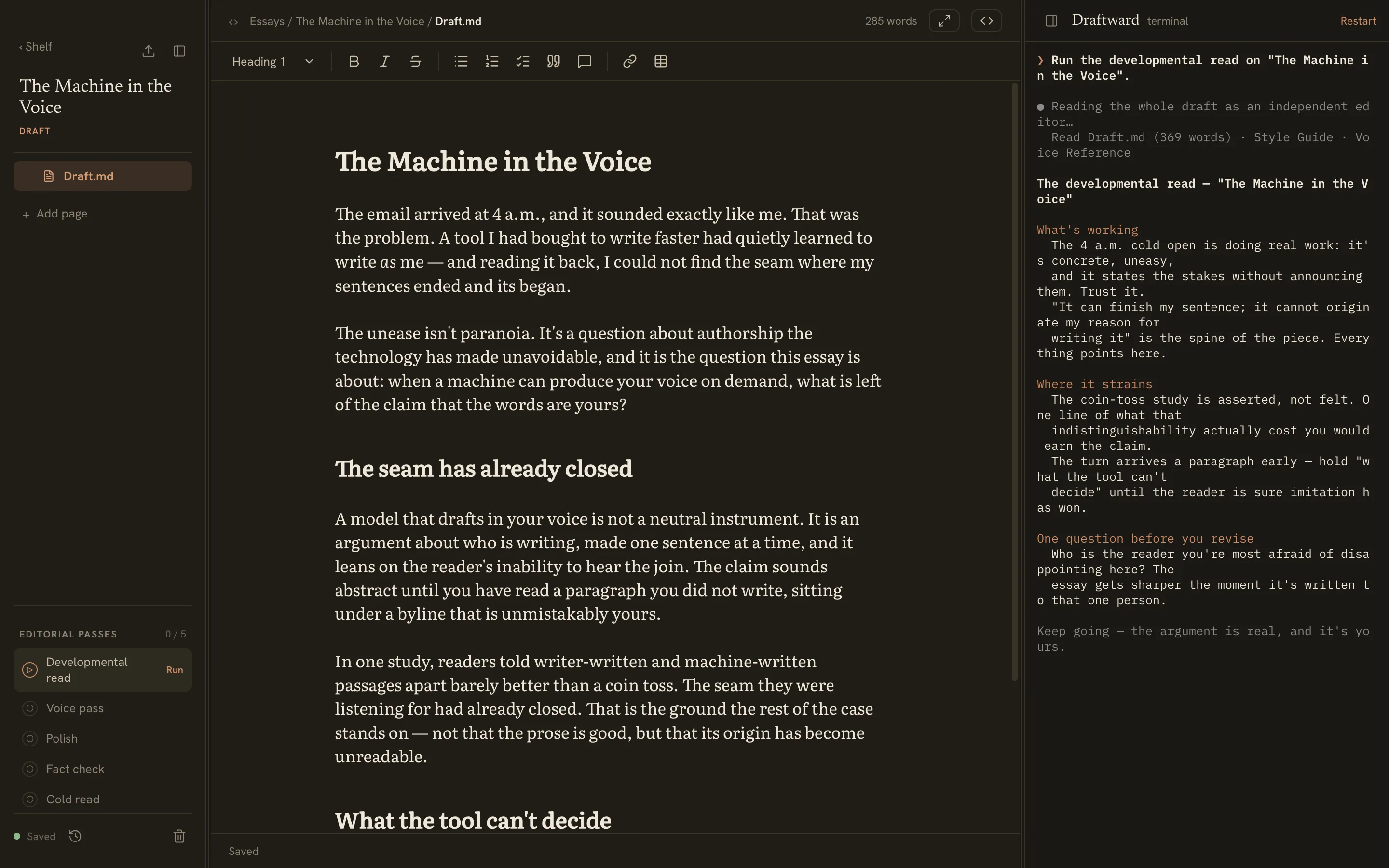
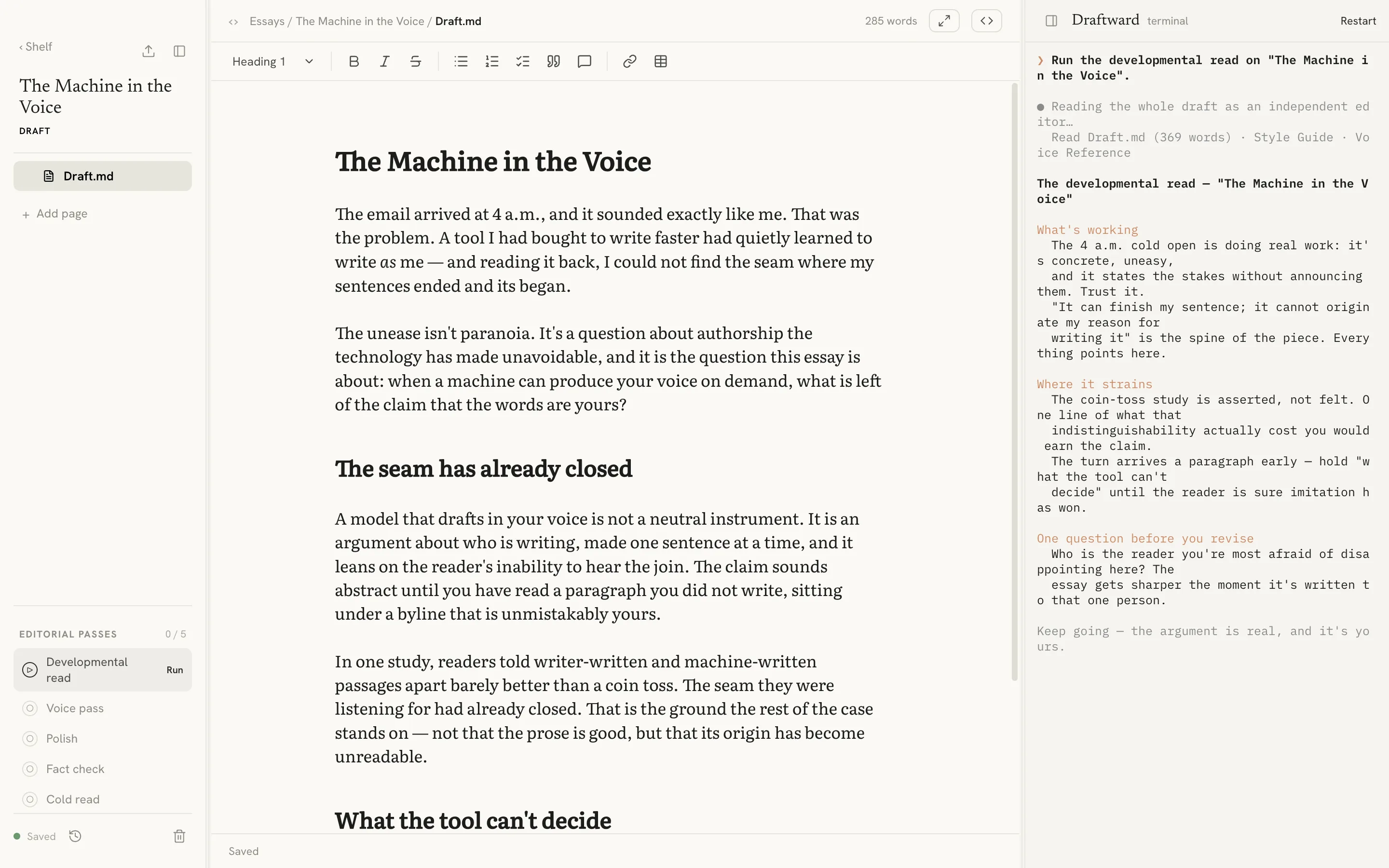
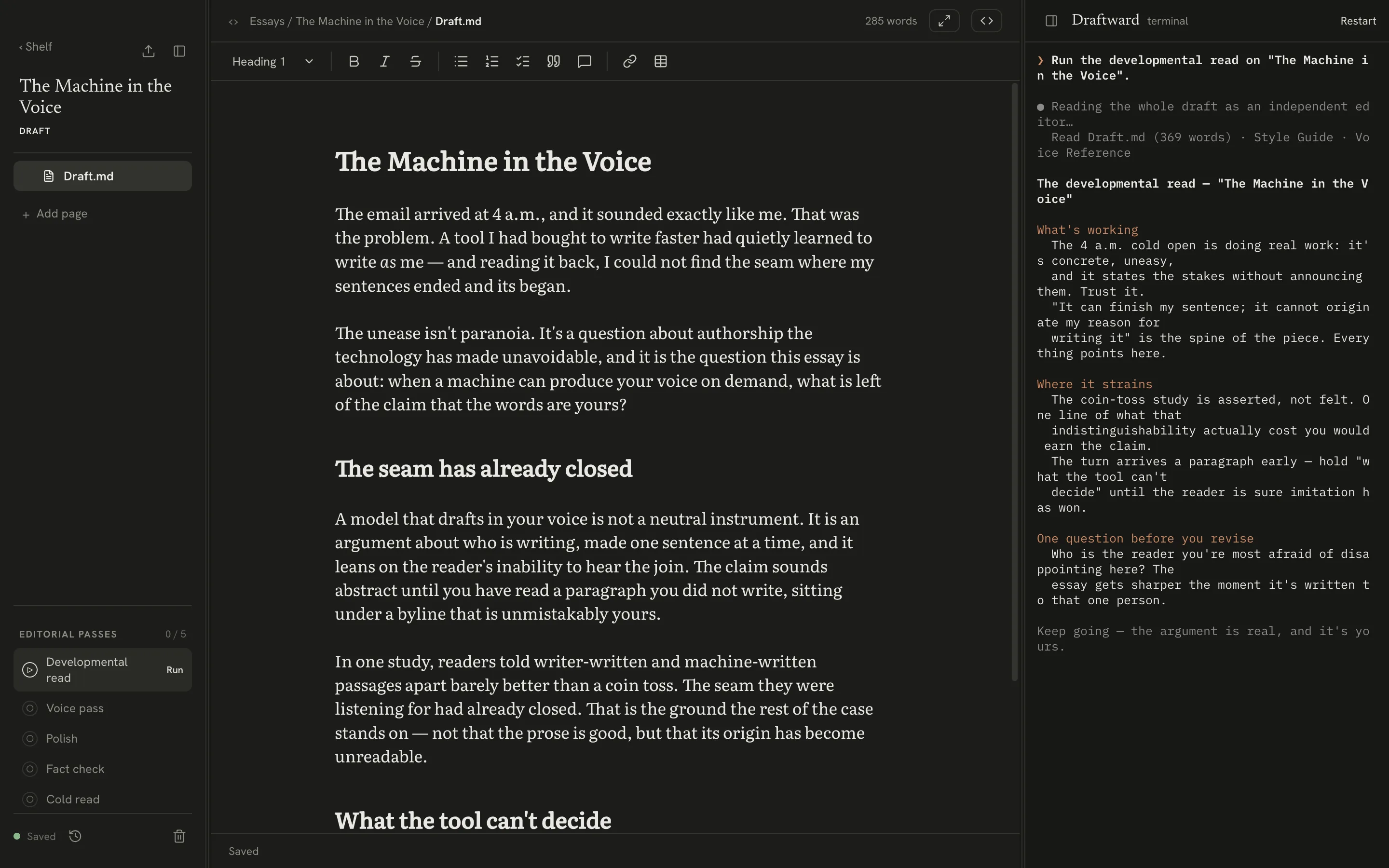
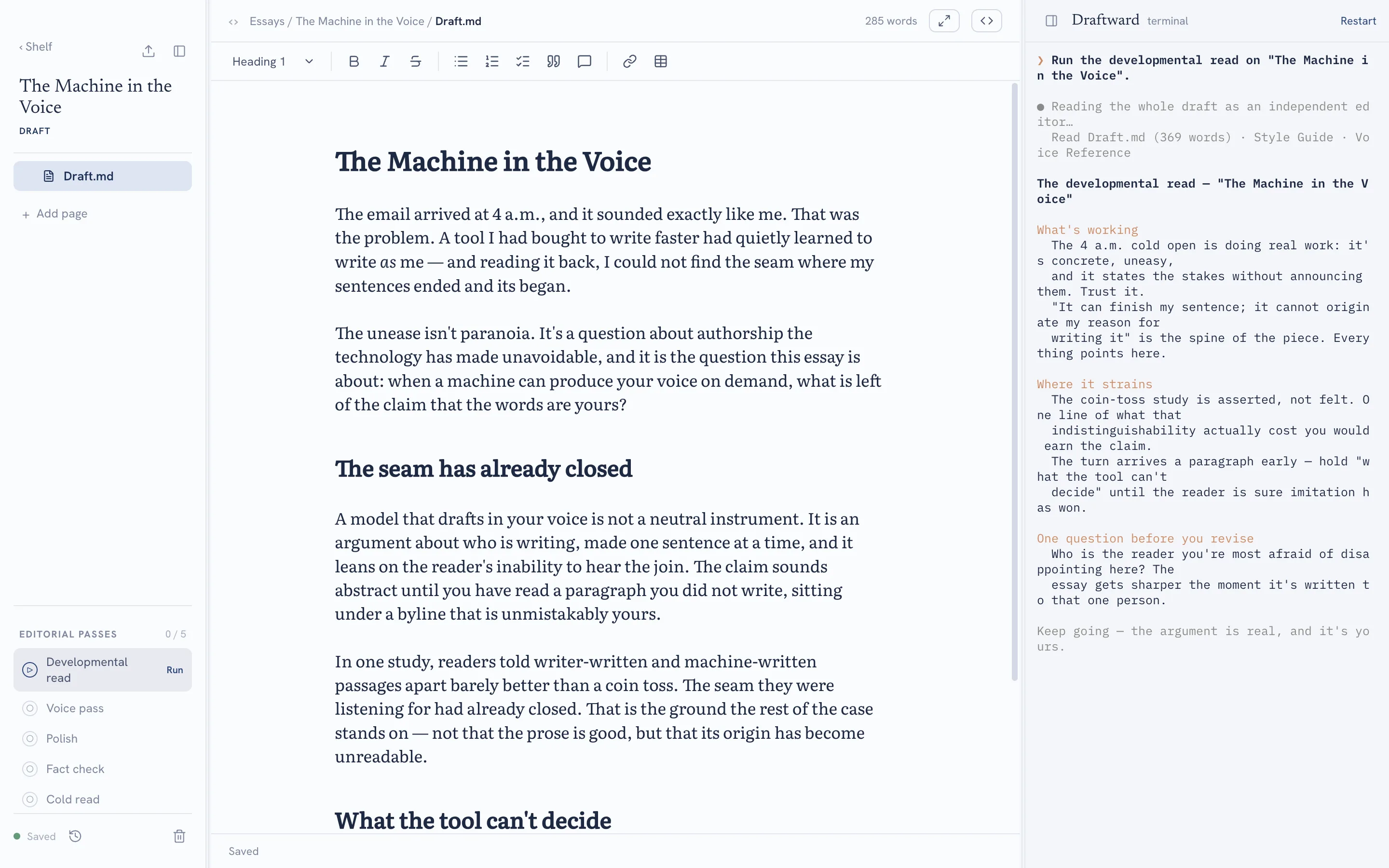
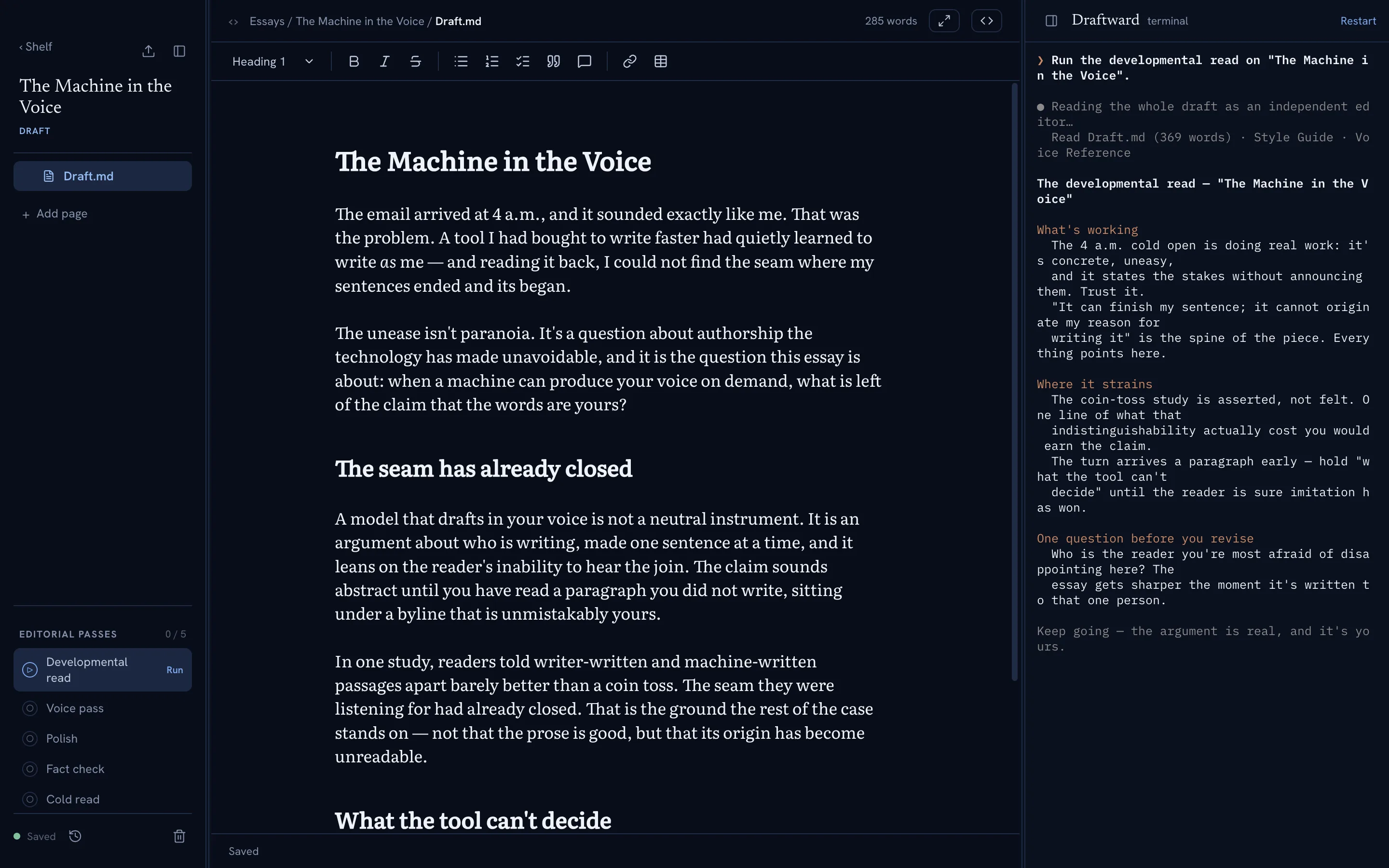
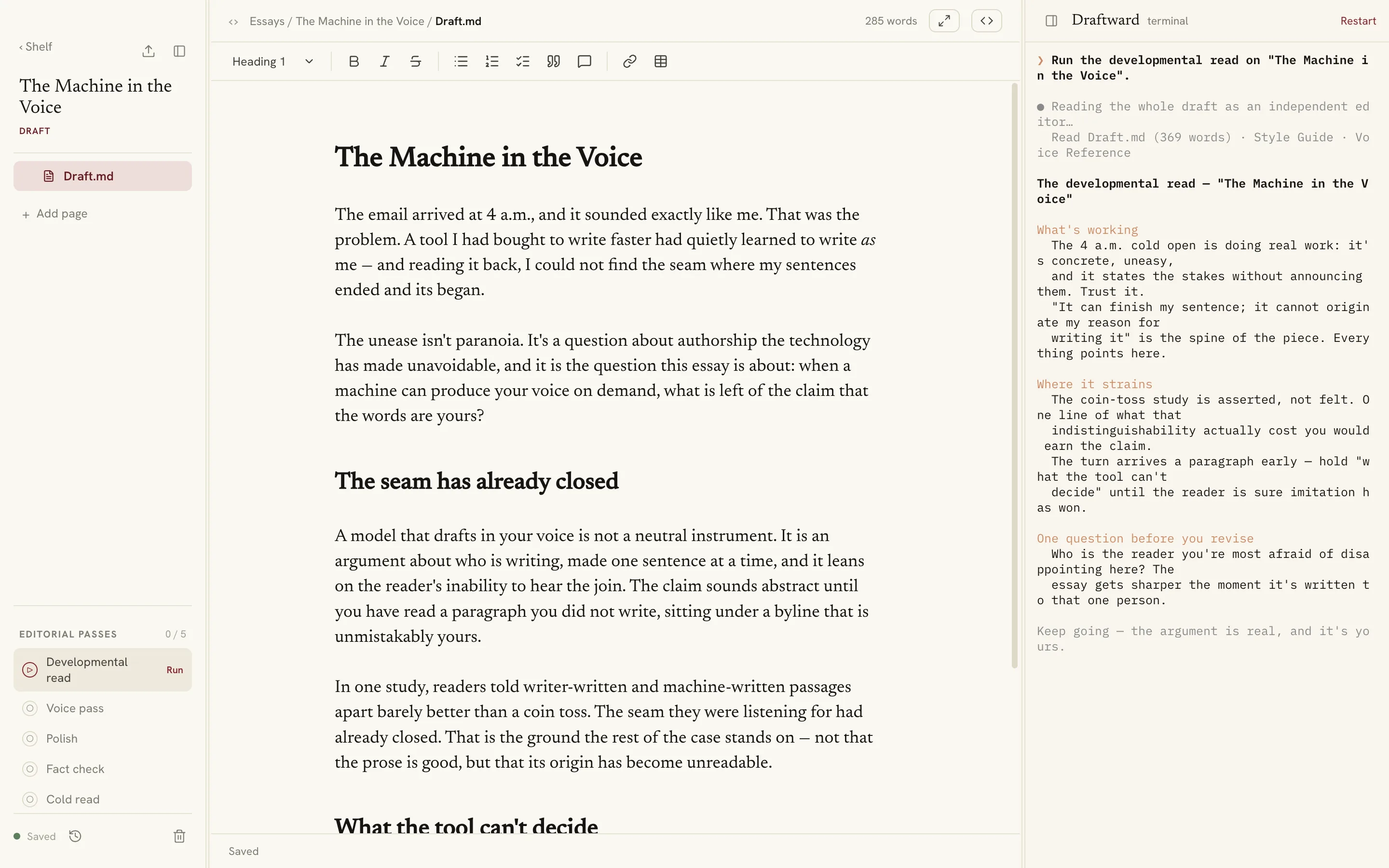
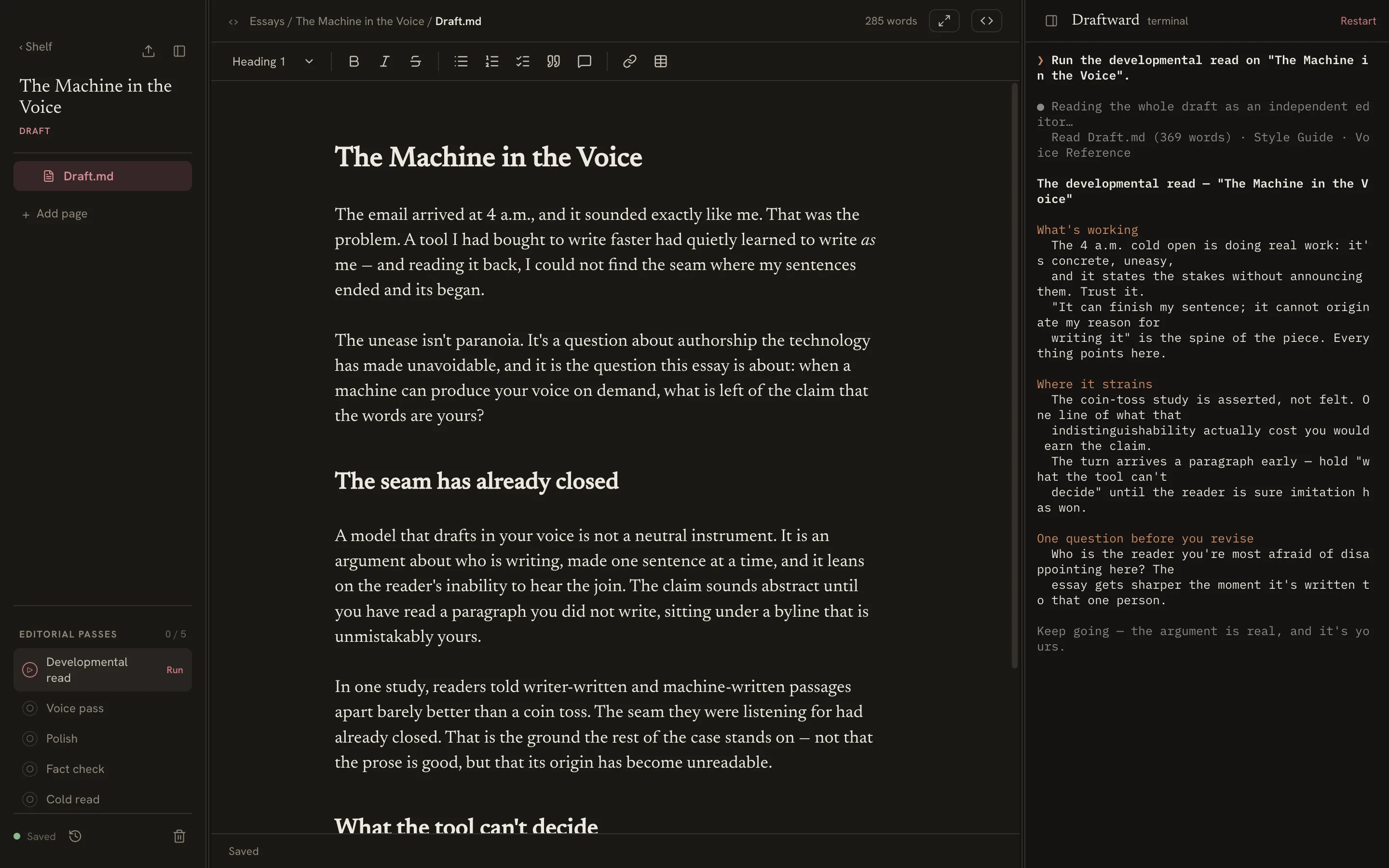
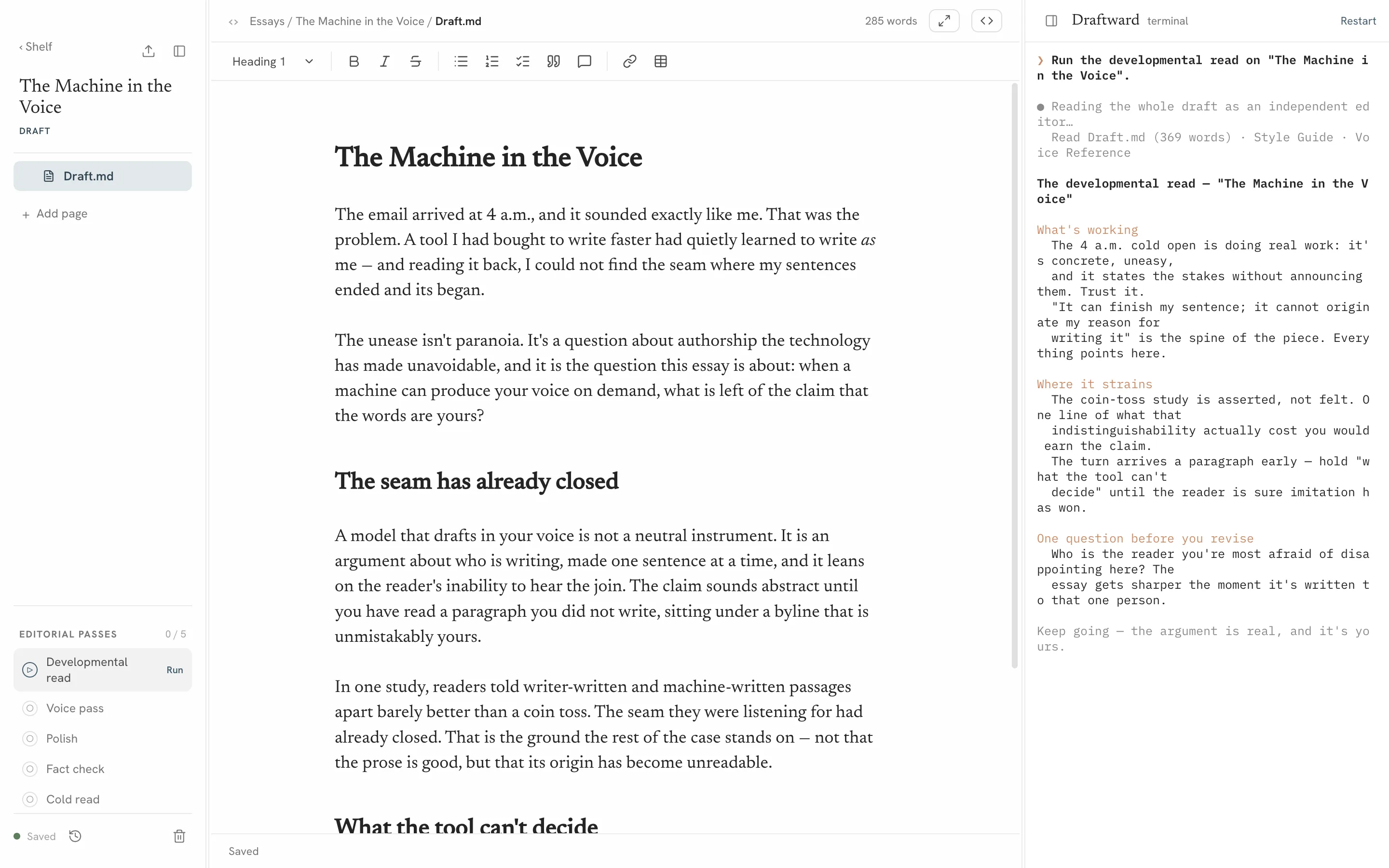
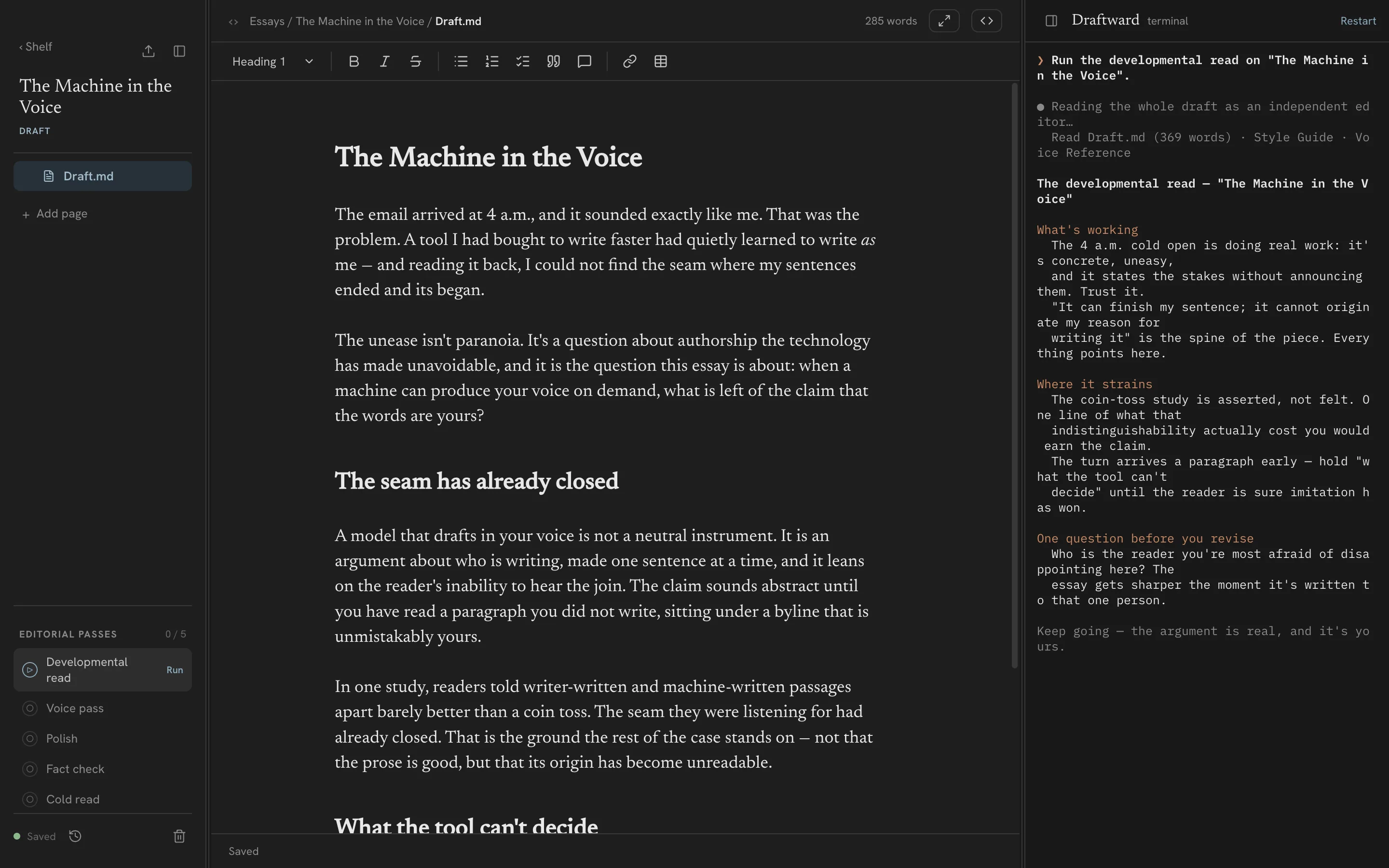
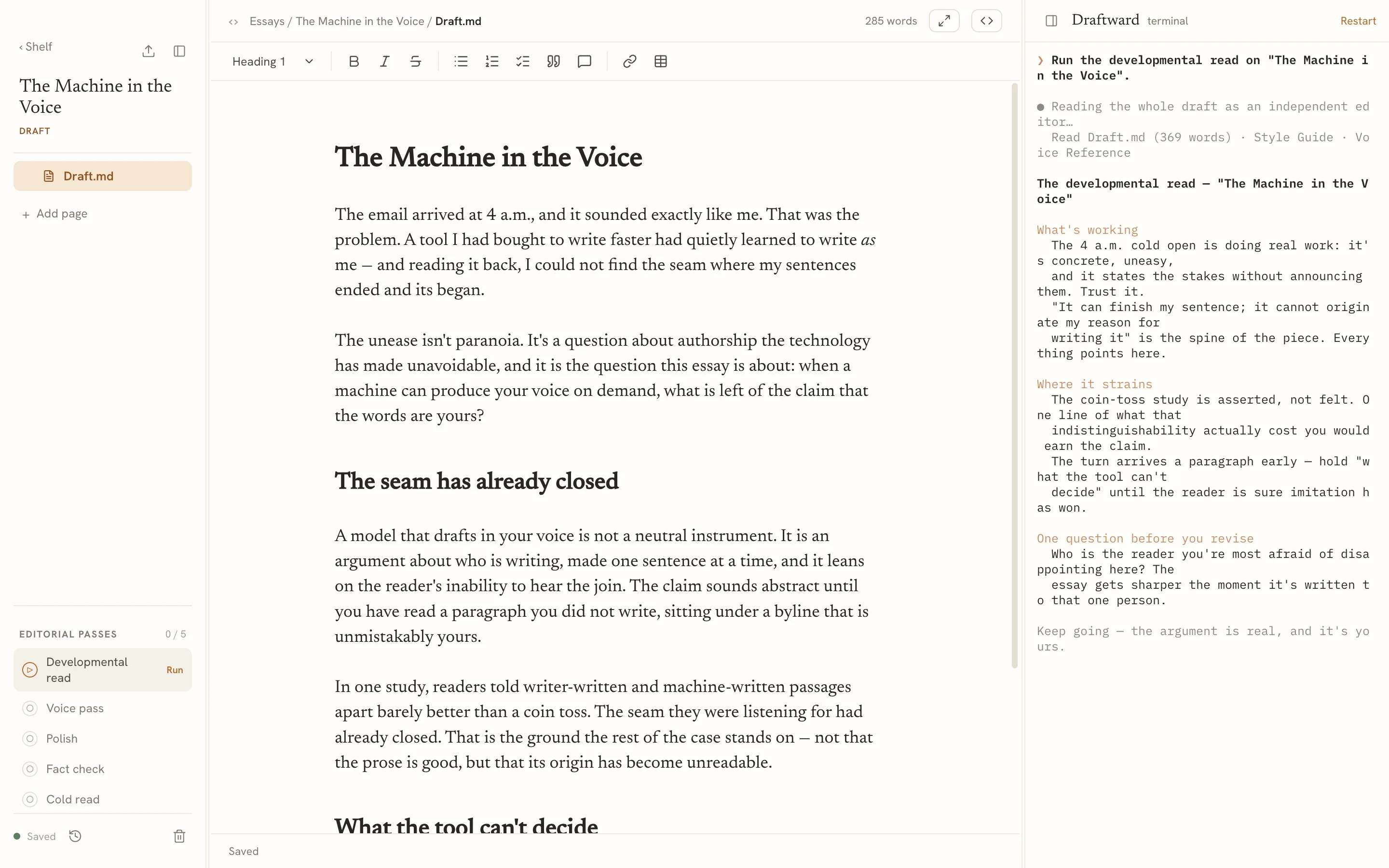
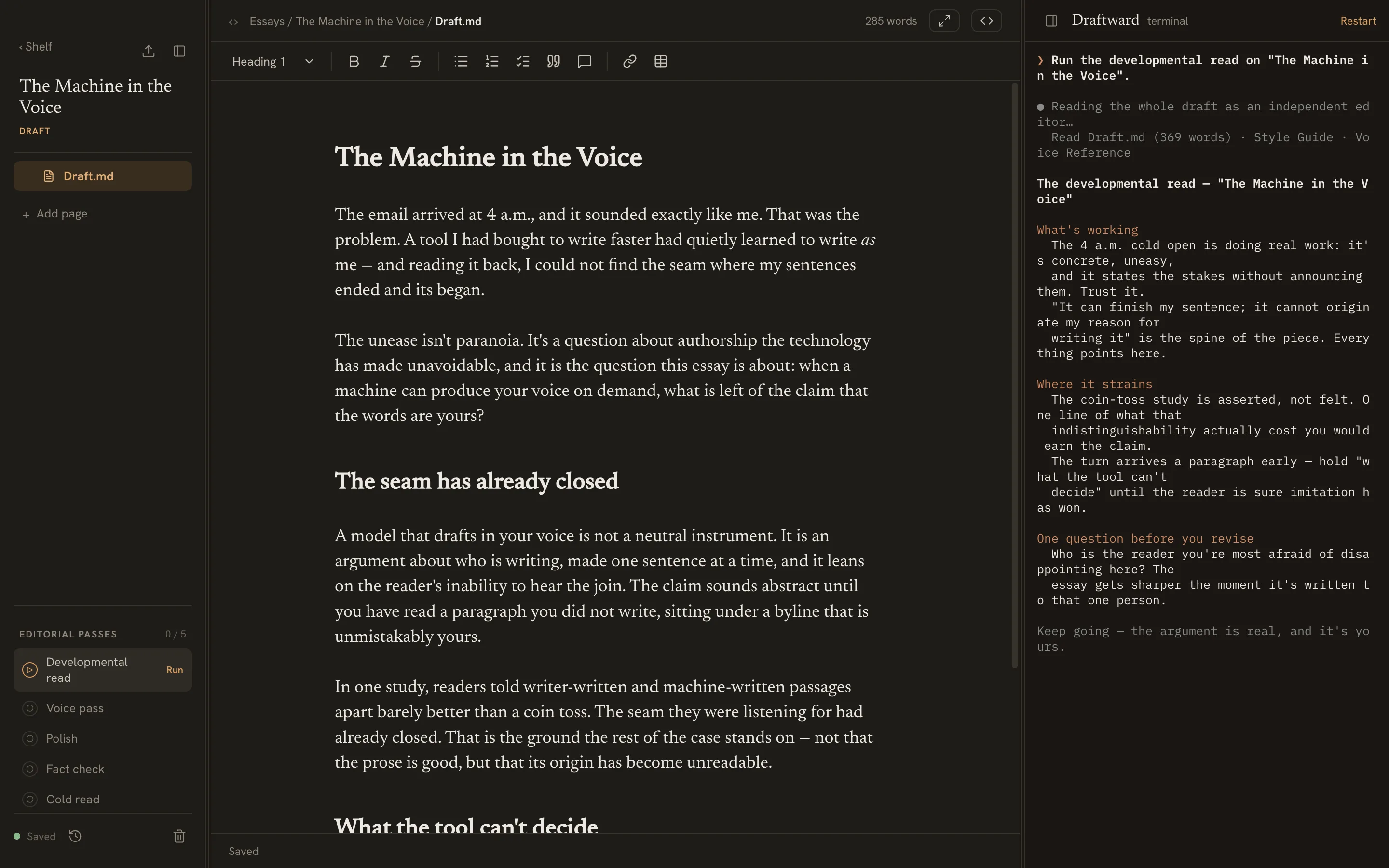
A clean white gallery page, near-black ink, and a proofreader-red accent — the Draftward default. Every theme comes in light and dark — and you can build your own from any two colors you pick.
Questions.
What does it cost?
Your first 30 days are free, and Draftward never asks for a card to start. After that it's $5 a month, or $45 a year. It runs on a writing engine you drive with your own subscription (Claude, any paid plan, or ChatGPT Plus/Pro), so there's no per-word billing on top — ever.
Is it a one-click article generator?
No. It's a developmental editor. You bring the idea and approve every step; the AI structures, researches, fact-checks, and drafts in your voice. The goal is a piece that could run in a publication you respect — not SEO filler.
What do I need to run it?
Most writers use a Claude subscription (any paid plan) or a ChatGPT subscription (Plus or Pro) — Draftward runs through Claude Code or Codex, and the launcher installs one for you if you don't have it. Grok, Gemini, and local models via Ollama or LM Studio work too.
Does my writing leave my computer?
Your whole body of work stays as Markdown files on your own disk — no cloud storage, no lock-in. Close the window and reopen anytime; the files are the complete state of your work.
Who is it for?
People who write serious nonfiction — essays, criticism, reported pieces, arguments — and want it well crafted. Equally at home for working essayists, Substack and Medium writers, and serious hobbyists.
Your writing room is ready.
Free for 30 days, and yours in a minute — no credit card. Runs on the Claude or ChatGPT subscription you already pay for.